![]() |
| Gondola on Sulphur Mountain |
![]() |
| Boardwalk leading to weather station |
![]() |
| Lake Louise |
![]() |
| Athabasca Glacier |
![]() |
| Street view of Banff |
Until the next time... is a blog usually focused on writing, music, and travel to places near and far. It concerns some of the things I've learned and some of the things I've messed up through the years. The blog also appears at www.michaelembry.com/blog.html.
![]() |
| Gondola on Sulphur Mountain |
![]() |
| Boardwalk leading to weather station |
![]() |
| Lake Louise |
![]() |
| Athabasca Glacier |
![]() |
| Street view of Banff |
Early in August my wife and I went on an 11-day tour of Banff, Glacier, and Yellowstone National Parks. Being nature lovers, it ranks as one of the most scenic trips we've had in our travels in the past few years.
With Covid-19 still raising its ugly head around the world, we were relieved to know that Canada only required the recommended vaccines, with the understanding they could still test us upon arrival in Calgary. But our tour company required us to have a negative Covid test within 72 hours of departure. We passed that test.
![]() |
| Calgary International Airport |
That trimmed our 12-day tour to 11 days. We were supposed to tour Calgary on the first day. Instead, the tour company provided a limousine when we arrived at the airport. The driver whisked us to our lodging in Banff, arriving about 30 minutes before the tour bus carrying our 31 fellow travelers.
The rest of the tour was simply wonderful. The only rain came the night before our return home. It stopped soon enough for us to take a quick walking tour of Jackson Hole.
Banff exceeded expectations with its towering mountains, gleaming glaciers, lustrous lakes, and breathtaking beauty. Glacier was scenic as well as we traveled the Going-to-the-Sun road to Logan Pass, viewing the lakes, waterfalls, and occasional wildlife. And Yellowstone was like an out-of-this-world experience with its geysers, prismatic pools, canyon, and wildlife. We finished with a raft ride on the Snake River with the Grand Tetons providing a dramatic backdrop to our adventure.Over the next few days, I'll have separate posts about our tour stops. There were a few interesting places along the way that I'll be sharing with you. I hope you come along for the ride.
Until the next time . . .
Lisbon is the vibrant capital of Portugal, a gorgeous city steeped in history, impressive architecture, cultural diversity, and friendly residents.
The only things that could spoil a visit would be the weather, sitting in an enclosed tour bus, and not having enough time to take in a lot of the activities and sights to satisfy the curious tourist. Unlucky me and my fellow travelers.
We encountered off-and-on rain during our two days in Lisbon, a city spread over seven hills and facing the Atlantic Ocean to the west. Of course, the weather is something you have no control over when on a guided tour. You take what you get from Mother Nature and deal with it. And you take along an umbrella or rain jacket just in case.
Along the way to our hotel, we drove past many places that I'd seen on YouTube travelogues, Rick Steves's videos about Lisbon, and the three books about Portugal that I had perused in the months before departing from my old Kentucky.
I learned about an earthquake in 1755 that devastated the city and much of Portugal, as well as parts of Morocco and Spain. Up to 50,000 people died and 85 percent of Lisbon's buildings crumbled to the ground in one of the worst earthquakes in history. It's often referred to as the Great Lisbon earthquake.
But you're not here for a history lesson.
![]() |
| Cristo Rei monument |
By the way, I seldom take photos from a bus because I don't like to see the reflection of the interior from the windows.
What we saw was part of my bucket list, so all was not lost. I just wished I could have seen more of what the city offered to visitors.
We visited the impressive Jerónimos Monastery, a UNESCO World Heritage Site which contains the tomb of Portuguese explorer Vasco da Gama and a few other notable citizens.
![]() |
| Vasco da Gama sarcophagus |
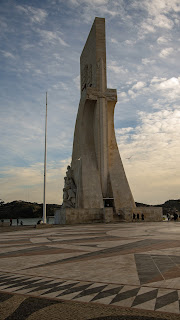
From there we went to the massive Monument of the Discoveries, remembering seafaring explorers such as Henry the Navigator, Vasco da Gama, Pedro Alvares Cabral, and other luminaries from the 15th and 16th centuries.
![]() |
| Monument of the Discoveries |
We made a brief stop at the Belém Tower, a 16th-century fortification on the northern bank of the Tagus River. It also served as a departure-and-arrival place for the fearless explorers of the world.
![]() |
| Belém Tower |
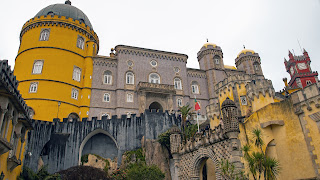
The principal attraction of the Lisbon stop was the colorful Pena Palace, another UNESCO World Heritage Site located atop a hill in the Sintra Mountains. It began in the Middle Ages as a small monastery, but like many places in 1755, the Lisbon Earthquake destroyed it.
![]() |
| Pena Palace |
King Ferdinand II built a summer residence for the royal family at the site, with construction between 1842-54. The castle has an eclectic feel with its colors and styles—because the king wanted it that way. I should mention that it rained during our visit. After touring the palace, we spent part of the afternoon in charming Sintra. I also learned that the pop singer Madonna once lived near the palace.
I'd like to return to Portugal, but only after I check off other places on my to-do travels. As the old saying notes, "you only go around once and then you ___" (you fill in the blank).
There are an estimated half-million expats living in Portugal, including about 50,000 Americans. That speaks well of the desirability and quality of life in the nation that it would attract others. I know I found it appealing.
I hope you've enjoyed my posts about Portugal. Feel free to "Follow" me on my journeys by clicking the button in the right column.
Until the next time . . .
Portugal's gorgeous Algarve region offers a variety of things to do and see with charming towns, beautiful beaches, rocky coastline, and historic sites. It is the southernmost region of Portugal with about a half-million inhabitants, but it triples during the vacation season with seasonal residents.
![]() |
| A marina in Portimão |
It was raining off and on and a blustery wind pushed you along the way when we ventured to the Cabo San Vicente Light House and Sagres Fort. Certainly not an ideal time to take photographs. Aside from that, it was another place to soak in the scenery, if you know what I mean. And when you're making what will probably be a once-in-a-lifetime visit, you make the most of the situation, regardless of circumstances.
![]() |
| The San Vicente Light House |

A statue in honor of St. Vincent
Something I found fascinating was a circular pattern inside Sagres Fort, believed to be a wind compass. It was discovered in the 18th century and excavated in 1919. That's the Atlantic Ocean past the walls.

Portuguese constructed the fort in the 16th century
Because of the inclement weather, we had to postpone a boat ride from quaint Lagos along the rocky coast until the second day of the trip. There were no complaints from my fellow travelers.
A bumpy and splashy boat ride along the rugged coast ranked as one of the highlights of the tour, perhaps because it has an amusement element for the adventurous side in a few of the travelers.

Colorful and laid-back Lagos
The next stop will be Lisbon. Come along for the ride (Hint: hit the Follow button in the right column)!
Until the next time . . .
Évora is a charming and historic city in central Portugal with relics from Roman and Moorish influence before and during the Medieval period, including protective walls, a temple, several cathedrals, and remains of a royal palace.
![]() |
| Group following the guide |
![]() |
| Church of St. Francis |
![]() |
| Bones in the Chapel of Bones |
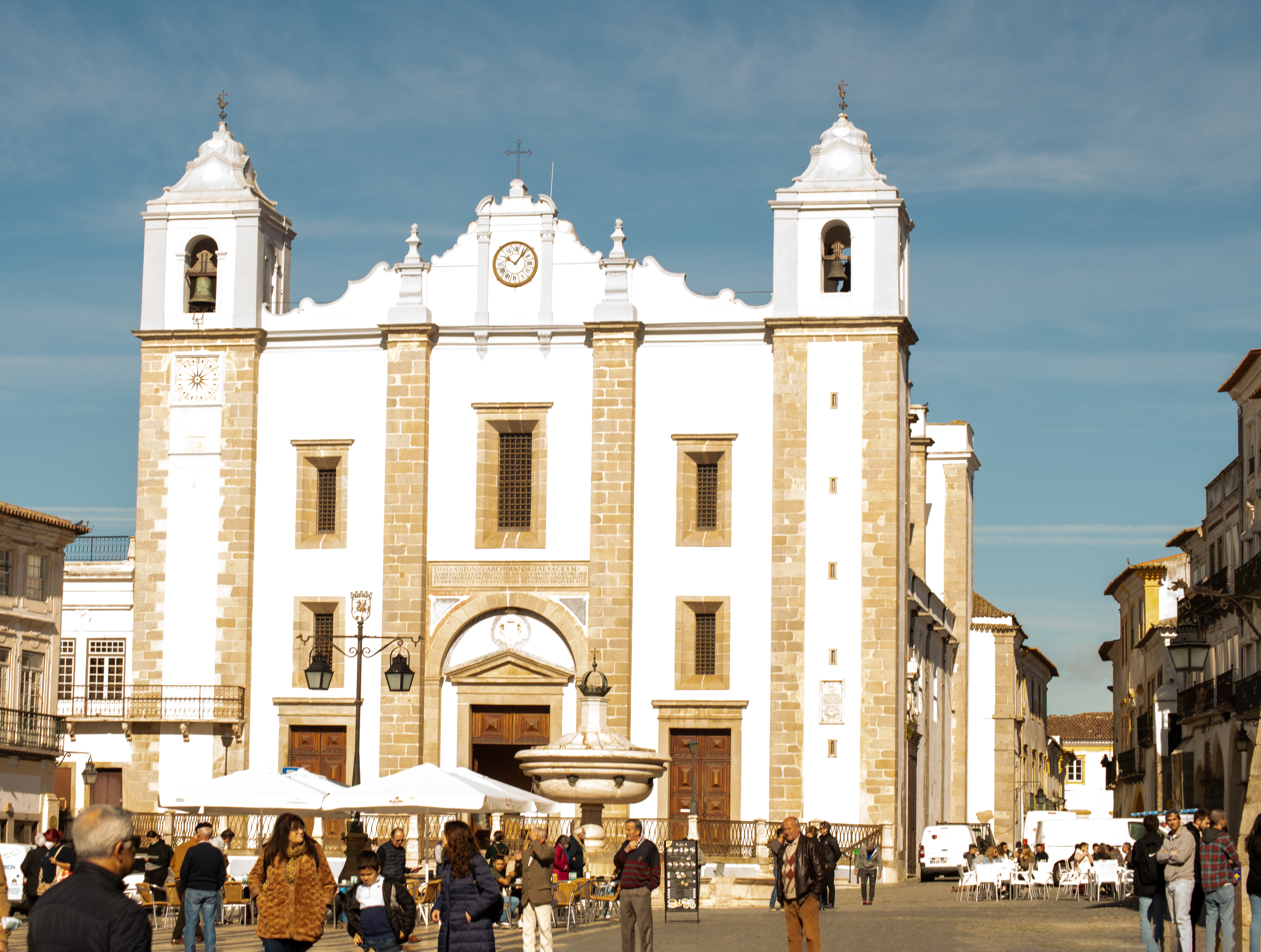
Walking on the cobblestone street, we headed to the Old Town square of Évora, where there are shops and restaurants. People congregated to eat at tables next to a fountain, while others sat on benches along the perimeter to chat or take in the sunshine. For me, this was one of the most relaxing places on the tour.
![]() |
| Church of Santo Antao in Old Town square |
Now on to some other sites in this enchanting place.
![]() |
| Sentry post along wall |
![]() |
| Side street |
![]() |
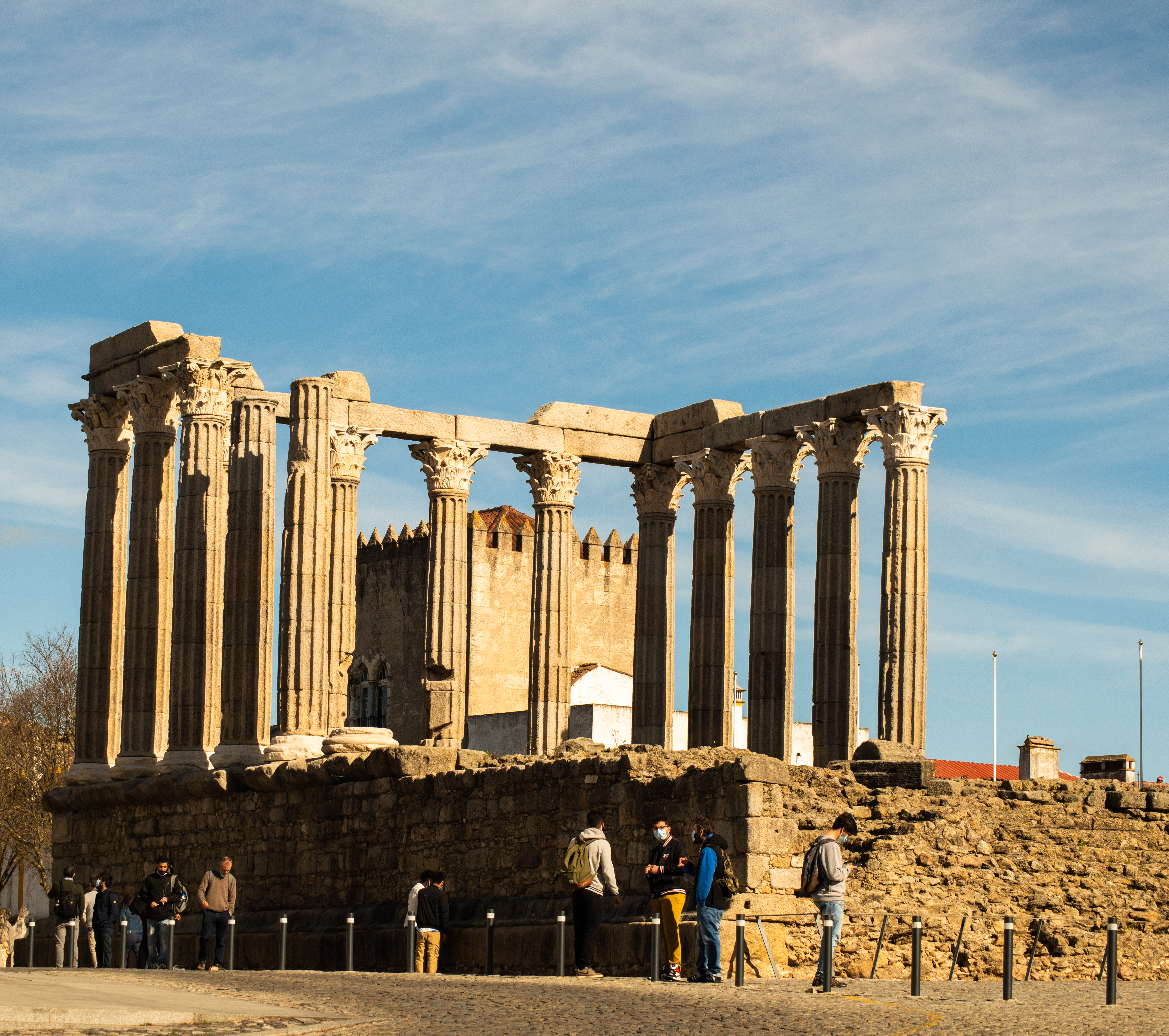
| Temple of Diana, built in the first century |
![]() |
| Church of Grace |
| Remains of the Royal Palace |
| Bust of Dr. Francisco Eduardo de Barahona, a benefactor of the city, in the Garden of Diana |
| Évora Cathedral |
| Bark stripped from cork oak trees |
![]() |
| Belltower at the university |
![]() |
| King Joao III statue |
![]() |
| Joanine Library |
![]() |
| The Rainha Santa Isabel bridge crossing the Mondego River |
![]() |
| The Tricana of Coimbra sculpture, honoring a woman of the city |
![]() |
| Sculpture celebrating Fado guitar |
![]() |
| Monument to 19th century Prime Minister Joaquin Antonio de Auigar |
![]() |
| Coimbra street scene |
![]() |
| Shopping district |
![]() |
| Santa Cruz Church and Monastery |
I suppose one adventure of travel is making connecting flights at various airports. The ideal is to board a plane at your home airport and fly nonstop to your destination. That's highly unlikely if you're flying overseas in economy class. I like to think it adds to the adventure of seeing fresh places, even if it is an airport.
For my wife and I on our journey to Portugal, we flew out of Blue Grass Airport in Lexington, Ky., to O'Hare International in Chicago, then a long flight to Zurich Airport in Switzerland (we can now say we've been to Switzerland), and then on to Porto Airport in Portugal. Enough about airports.
As I've probably mentioned in previous posts, we take guided tours on our trips to Europe because we like someone holding our hands and leading us to various sundry places. Well, it's not quite that bad because we do like the free time to explore on our own, but a director gives us ideas and can point us in the right direction. And she is someone we can contact if we get totally lost!
![]() |
| The Douro River at twilight |
Porto is a historic city, much like most European places visited by Americans. We began with a walking tour of the Ribeira District, which borders the Douro riverfront. It's a UNESCO World Heritage Site.
![]() |
| Porto Cathedral |
Our first stop was the Porto Cathedral, overlooking the Douro River. Construction on the Romanesque structure began in 1110 and was completed in 1737, a mere 627 years. An impressive pillory stands on the grounds. A statue of Vimara Peres, a ninth-century nobleman, stands near the entrance.
![]() |
| Vimara Peres |
Without going on and on, here are a few other highlights from our tour of Porto that including bus stops along the Atlantic coastline and a leisurely boat ride on the Douro River.
![]() |
| Statue of Prince Henry the Navigator |
![]() |
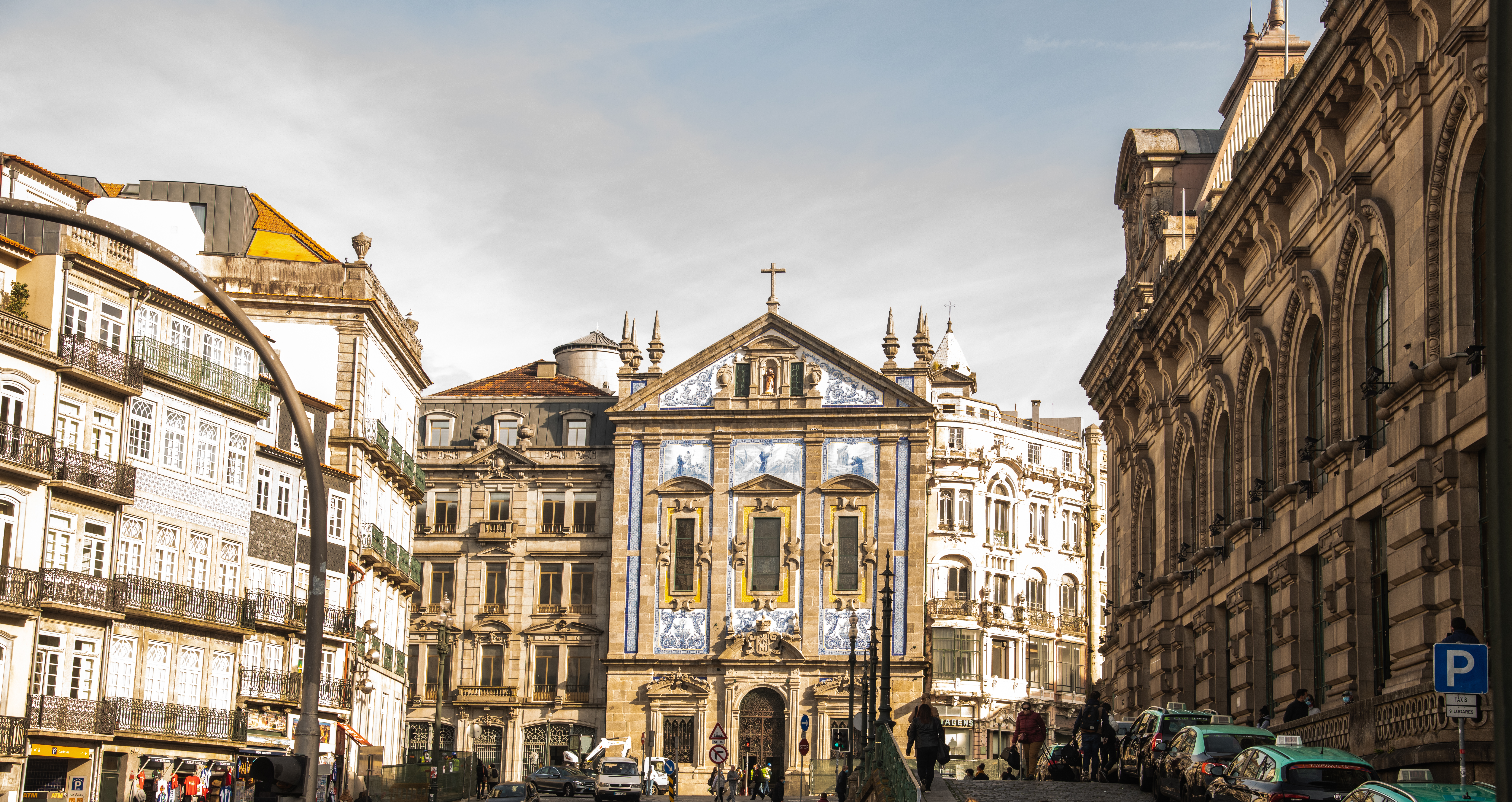
| A church with a blue-and-white tile facade |
![]() |
| Restaurants in the historic Ribeira District |
![]() |
| Boats on the Douro River |
![]() |
| Barrel in a warehouse containing Porto wine |
There was so much to see and do in Porto but so little time as we had to move on to our next stops in Coimbra and Evora. If ever I return to Portugal, Porto is a city where I want to spend a lot of time.
Until the next time . . .