Monday, December 19, 2022

A Post about Nothing

 It's been six weeks since I posted anything on this blog site. For those who are subscribers, I apologize. For others, I will return at some point in time. Bear with me. 

The point I want to make today is that I'm not going to post something for the sake of posting something. If I don't have anything to say, I'm not going to fabricate some line that is a waste of my time, and more importantly, of yours! 

I do intend to get back to regular posts, after the holidays and when I have the time to write something worthy of your time. 

As many of you probably know, I try to avoid politics. It's not that I'm not political, but I want my blog to be an escape from the polarization and turmoil on the political front. Furthermore, there are more than enough political blogs out there to more than satisfy political junkies.

I'll continue to focus on travel, music, books, and occasionally items that capture my fancy. I also have another novel that I need to finish in the next few months.

I wish everyone a holiday season of peace and happiness — and hope you spread joy to others in this uncertain world we live in.

Until the next time . . 

Tuesday, November 1, 2022

On the Road: A short trip to Asheville, N.C.

Asheville is a jewel in the Blue Ridge Mountains, a small city with big appeal

Photo © Michael Embry 2022
Downtown Asheville

My three-day visit to North Carolina in October exceeded expectations. I knew some things about the city, such as the famous Biltmore Estate, and did some research on other places to experience.

For many years, while traveling to places in the southeast, I would drive past the Asheville exits on the interstate. Looking back, that was my loss. But I'm glad I was able to overcome the foolish decision of my younger years. Yep, live and learn.


Photo © Michael Embry 2022
Blue Ridge Mountains 
It's hard to beat driving to that area of the country in October, taking in the palette of autumn colors splashed across the trees in the rolling peaks and valleys. Once you enter the Great Smoky Mountains National Park, near Knoxville, Tenn., and straight through to the Blue Ridge Mountains, the reds, yellows, oranges, and browns rival nature's display in other parts of our beautiful nation known for colorful fall foliage.

Asheville was named after Samuel Ashe, the ninth governor of North Carolina. The city of nearly 100,000 residents has a thriving arts scene, great restaurants, brew pubs, a noted bookstore (Malaprop's), interesting Art déco architecture, and a state university and several private colleges. There's a lot to this small city. 

The Biltmore is the primary tourist destination for many people coming to the area, but we skipped it. My wife had been there before with friends and took lots of photos. And I have seen many images, watched a documentary and read articles about the historic place to where I felt I had already been there. Maybe next time. 
Photo © Michael Embry 2022
Thomas Wolfe Memorial

Downtown Asheville is very walkable and among the places we saw while strolling the streets were boyhood home of writer Thomas Wolfe ("Look Homeward, Angel" and more), the Basilica of St. Lawrence, the Asheville Art Museum, and various artworks along the way.

A highlight of the trip was visiting the Carl Sandburg National Historic Site in Flat Rock, about 30 miles south of Asheville, where the "Poet of the People" lived from 1945 until his death in 1967. His 264-acre Connemara estate includes his stately white residence, a goat farm where his wife, Lilian, raised champion dairy goats, and five miles of hiking trails. Sandburg was the recipient of three Pulitzer Prizes, twice for poetry and once for a biography of Abraham Lincoln. 

Photo © Michael Embry 2022
Carl Sandburg home

Sixteen miles east of Asheville is the art-and-crafts town of Black Mountain, named after the train depot. It's a quaint town that is welcoming to tourists with shops and restaurants. It is also the birthplace of Grammy Award-winning singer Roberta Flack.

I plan to return to Asheville and take in more of the sights and sounds—and definitely spend more than three days in the area. There are plenty of outdoor things to do, and for all age groups, in and around this sparkling city.

Black Mountain
While driving back to our old Kentucky home, my wife and I discussed that had we known more about Asheville a few years ago, it might have been a place we would have considered to retire. It's too late for us, but if you're nearing that point in your life, you might want to give it some thought because it's a small city with a lot of appeal.

Until the next time . . . 


Thursday, October 27, 2022

Forty-first annual Kentucky Book Festival

 It will be a star-studded gathering of authors at the 41st annual Kentucky Book Festival on Saturday.

Around 150 authors, including yours truly, will take part in the day-long event at Joseph-Beth Booksellers in Lexington. It runs from 9:30 a.m. until 5 p.m. 

This will be my 11th appearance as an author, beginning in 1985 when it was called the Kentucky Book Fair and held in Frankfort. Newspaper journalist Carl West founded the fair in 1981. I also served on the executive board for six years, until it moved to Lexington in 2017 under the auspices of the Kentucky Humanities Council. 

This year's literary list of luminaries includes:

  • Jon Meacham
    Pulitzer-Prize-winning biographer Jon Meacham, author of "And There Was Light: Abraham Lincoln and the American Struggle."
  • Best-selling author Barbara Kingsolver, a Kentucky native, will sign her latest novel, "Demon Copperhead."
  • Pulitzer-Prize-winning novelist Geraldine Brooks, with her latest release, "Horse." 
  • Wendell Berry, a Kentucky literary legend and recipient of the National Humanities Medal, will have "The Need to be Whole: Patriotism and the History of Prejudice."
  • Western Kentucky University English professor and award-winning novelist David Bell will have his latest, "The Finalists," to sign. 
    Barbara Kingsolver 
  • Kentucky Poet Laureate Crystal Wilkinson will have her prose and poetry collection, "Perfect Black."

   Among other notables are Silas House ("Lark Ascending"), former Kentucky poet laureate Frank X Walker ("Buffalo Dance: The Journey of York"), Bobbie Ann Mason ("Dear Ann"), Emily Bingham ("My Old Kentucky Home: The Astonishing Life and Reckoning of an Iconic American Song"), former Kentucky poet laureate Richard Taylor ("Elkhorn: Evolution of a Kentucky Landscape"), and Ann Gabhart ("When the Meadow Blooms"). 

Geraldine Brooks

I belong to the Kentucky Writers Coalition, which will have six authors at the fair: Chris Helvey ("Into the Wilderness"), John Schaff and Robert Schrage ("Hidden Histories of Kentucky Political Scandals"), Georgia Green Stamper ("Small Acreages: New and Collected Essays"), Doris Dearen Settles ("Leira Clara's Flowers"), Richard Taylor (previous paragraph), and me ("Reunion of Familiar Strangers"). 

Click here for the complete author lineup, including books and bios.

Besides an opportunity to meet talented authors and have them sign their books, the festival will have panel discussions, interviews, and presentations throughout the day on many interesting subjects—for all ages. Click here for more information. Children's activities are listed here. 

Crystal Wilkinson

I almost forgot—the book festival is free (except for the books) and open to the public. It's a great time for book lovers and authors, and a wonderful opportunity to introduce youngsters to the joy of reading. 

Drop by Table 23 and say "hi." I'll have a bookmark for you that works on all books!

Until the next time . . .

Sunday, September 11, 2022

Destination Banff, Glacier, and Yellowstone National Parks: Notes Along the Way

 I always take a notebook or notepad with me when I travel. I usually write about a day's events after I return to the hotel, but sometimes I'll put down thoughts on the bus or when there's a break along the way. I don't trust my mind to remember everything I've seen or heard over a busy day.

My notebook
I also keep a small spiral notepad in my camera bag so I can jot down information about where I took a photo. I find it valuable, especially when I return home and begin sorting through the hundreds of images I've taken at various stops along the way. So, here are some of my scribbles from my recent trip to the Canadian Rockies, Glacier National Park, Yellowstone National Park, and other places before and after:


  • An American Airlines cancellation delayed the flight to Calgary one day. My wife and I were concerned because we had to take a COVID-19 test no more than 72 hours prior to our departure. We took ours on a Tuesday afternoon, so we were ready with our negative results. While our good neighbor to the north didn't require testing, our tour company did because it apparently didn't want travelers spreading the disease to other passengers. It was an inconvenience, but it made sense. But we were looking forward to the tour of Calgary. 
  • The tourists
    We made it to Calgary International Airport after a 3.5-hour layover at Chicago's O'Hare Airport. Everything was going smoothly through customs until we encountered a 20-something security guard near the exit. Before arriving in Canada, we had to complete an online ArriveCAN questionnaire on our reason for visiting, where we were staying, and how long we would be in their country. The security guard asked us what we were doing in Canada ("tourists"), where we were going ("Banff"), what we were going to do there (we gave him a perplexed look and said we were with a tour group), and then he asked where we were staying (I probably rolled my eyes, began pulling out travel papers and wondering if he was aware of ArriveCAN before he waved us on). I wasn't about to let him spoil this trip by getting us off on the wrong foot. 
  • During our time in Banff, which is Canada's first national park, I didn't see any graffiti on buildings, bridges, or walls. Anywhere. I don't recall seeing any in Calgary or during the drive to Banff. Nice and clean. Disheartening images I've seen on trips to other places in the world have been the defacing of structures in Rome, London, Budapest, Buenos Aires, Athens, and cities across the U.S. It's ugly. 
  • We saw quite a few bicyclists along the highways, heading to scenic spots and wilderness areas. Our tour guide said that bears refer to them as "meals on wheels."
  • Photo by WikiPedant at Wikimedia Commons
    Wildlife overpass on Trans-Canada highway
    On the Trans-Canada highway, we saw animal overpasses and underpasses that provide elk, bears, deer, and other wildlife safe passage through areas and reduce the chances of encounters with motorists. There were also game fences from the highway to deter wildlife from reaching the highway. A study reported by The Wildlife Society found that fences offer the best way to reduce roadkill.
  • I learned that the caribou, Canada's majestic deer, is on the endangered species list. 
  • A highway sign in Montana: "Hate speeding tickets? Raise your right foot."
  • Two of our 31 travelers feel sick and tested positive for COVID-19 during the trip. They were quarantined for five days in the hotel, one in Missoula and the other in West Yellowstone. It made me wonder how many folks may have come down with the virus after they arrived home?
  • The only complaint I heard on the tour was the bus going too fast, especially around photographic spots. I wish we could have stopped at entrances to the parks so we could take photos of welcome signs (I like to use them in photo books I make after trips). 
  • Our return flights from Jackson Hole to Chicago to Lexington, Ky., were uneventful, thank goodness.
  Until the next time . . . 

Friday, September 9, 2022

Destination Banff, Glacier, and Yellowstone National Parks: Side trips

One of my joys when traveling is to go off the beaten path and explore places that expand one's experiences in life. While Banff, Glacier, and Yellowstone national parks are certainly highlights of my recent guided tour, it was several side trips that added richness to the journey.

Photo © Michael Embry 2022
Head-Smashed-In Buffalo Jump
After three days in Banff, the bus headed south in Alberta, Canada, to Head-Smashed-In Buffalo Jump, a UNESCO-designated World Heritage Site. The name of the place puzzled me, but learned that it was about the three Blackfoot tribes and their relationship with the buffalo for over 6,000 years. There is an impressive museum and interpretative center that explains how the tribes lured and sent a herd of buffalo over the towering cliffs and how they used the kill to provide food, clothing, and other necessities for life on the plains—in physical and spiritual meanings.

Photo © Michael Embry 2022
International Peace Park 
Our next stop, also in Alberta near the U.S. border at Montana, was Waterton Lakes National Park. The picturesque park was established in 1895 and named after conservationist Charles Waterton. The pristine surroundings include the historic Prince of Wales Hotel, which opened in 1927, and the International Peace Park.  


Photo © Michael Embry 2022
Museum of Plains Indian 
After crossing into the United States, we spent the night in Browning, Montana, the headquarters of the Blackfeet Indian Reservation.  A point of interest is the Museum of the Plains Indian, which, unfortunately, was closed when we arrived. I wish the museum had been part of the tour rather than Browning being an overnight stop on the way to Glacier National Park.  There was a busy casino, but I don't gamble when it comes to money.
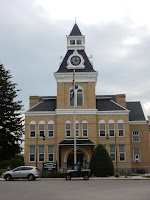

Photo © Michael Embry 2022
Beaverhead Courthouse
in Dillon 
On the way to Yellowstone National Park, we stopped for a delicious lunch at Papa T's in Dillon, a town of 3,880 residents established in 1857 and named after Sidney Dillon, president of Union Pacific Railroad. I had a few minutes to explore parts of downtown before boarding the bus to resume the trip. It's an interesting city undergoing some renovation that will surely draw visitors.


Our next destination was Virginia City, Montana, not to be confused with Virginia City, Nevada, where Adam Cartwright and his sons spent time in the TV show "Bonanza." But I bet this preserved western ghost town, a National Historic Landmark District, is just as interesting. A sign proudly proclaims that the town has "been resisting change since 1863."
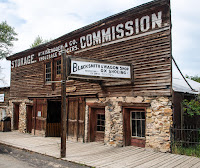

Photo © Michael Embry 2022
Old building in Virginia City
Virginia City was once a booming place with a population of around 10,000 during the gold rush in the mid-19th century, even serving as the capital for 10 years. The population in 2020 was 219, most of whom probably maintain the buildings and operate the businesses in this historic town for tourists. 


Photo © Michael Embry 2022
Snake River and Grand Tetons 
After Yellowstone National Park, we spent two days at Jackson Hole, Wyoming. The highlight was a raft ride on the Snake River, with the majestic Grand Tetons as a backdrop. We also had time to walk in the town, which is like many tourist towns in the U.S. with expensive restaurants and souvenir shops. 


I hope you've enjoyed the side trips. Follow me (right column) for more of my travels. 

Until the next time . . .


Sunday, September 4, 2022

Destination Banff, Glacier, and Yellowstone National Parks: Yellowstone National Park

 Yellowstone National Park had been on my travel bucket list for many years and it certainly lived up to expectations in August as a fascinating and unforgettable place to visit with its geysers, canyons, colorful springs, waterfalls, and assorted wildlife. 

Photo © Michael Embry 2022
Steamy geysers
I was concerned when flooding ravaged parts of the park on June 12, washing out roads and damaging infrastructure about seven weeks before my tour was scheduled for a two-day visit. But give credit to the National Park Service staff for making the needed repairs that opened most of the park for tourists. 


Yellowstone is the oldest national park in the world, celebrating its 150th anniversary in 2022. Nearly 5 million people visited the park in 2021, the most on record and a 28 percent increase from the Covid-19-affected travel season in 2020. The park ranked third among national parks for visitors in 2021, behind the Great Smoky Mountains and Zion. 

Photo © Michael Embry 2022
Mammoth Hot Springs
While it attracts many visitors, the park didn't seem crowded except in the Old Faithful area. Even there, people were on the hiking trails, visiting the lodge, information center, and restaurants, or congregating at the many observation points. 

Yellowstone is a vast park, covering 2.2 million acres, mostly in the northwest corner of Wyoming (96 percent) with tiny sections in Montana (3 percent) and Idaho (1 percent). That's probably another reason the park wasn't congested, as it offers innumerable activities for visitors. My tour entered from the north, near the tourist town of West Yellowstone, Montana.

Photo © Michael Embry 2022
Old Faithful
Old Faithful is the famous geyser most associated with Yellowstone, but there's much more to see and experience at the park. There are about 500 geysers, about half the number in the world, along with other hydrothermal wonders that seem otherworldly. 


Photo © Michael Embry 2022
A boarded path at the hydrothermal pool
For the non-backpacking visitor, Yellowstone provides paved and boardwalk paths to view the many sights. It's also pet-friendly, although certain areas are off limits to our furry friends, especially near geysers and geothermal pools. 


Photo © Michael Embry 2022
Bison grazing

And there's wildlife, although I didn't see many animals during my visit other than several bison herds. It amazed me that some tourists, despite the warning signs to keep their distance from bison (and other animals), would approach the beasts as if they were at a petting zoo. Bison gored three people in July. I guess some folks never learn to heed warnings.


Yellowstone was worth the visit and more. I recommend you experience it for yourself. You will not be disappointed.

Until the next time . . .


Thursday, September 1, 2022

Destination Banff, Glacier, and Yellowstone National Parks: Glacier National Park

 Glacier National Park is a wonder to behold.

Photo © Michael Embry 2022
Red Jammer
 Unfortunately, my visit to this majestic park was for only a few hours, boarding a 1936 vintage Red Jammer at St. Mary with 11 other passengers and traveling the Going-to-the-Sun Road to Logan Pass. But along the way, you can't help but marvel at the mountains, valleys, waterfalls, and wildlife that passes before you along the way. Encompassing about 1 million acres, it was designated a national park in 1910.


Photo © Michael Embry 2022
Glacier National Park

You also see scores of hikers who get off the beaten path to explore the beautiful region of North America, sometimes referred to as "The Crown of the Continent," from an article by renowned conservationist George Bird Grinnell in 1901 that sought to preserve the pristine area at includes the southwest corner of Alberta, Canada. I wish I could have jumped off the bus and joined the trekkers, at least for a few miles.


Photo © Michael Embry 2022
My wife and I 
Logan Pass is named after Major William Logan, the first superintendent of the park. It sits at an elevation of 6,646 feet along the Continental Divide. A visitors' center with limited parking (the NPS recommends taking a shuttle to Logan Pass) and hiking paths to gorgeous views of the park await the adventurous traveler.

Because of climatic changes, every named glacier in the park has shrunk between 1966 and 2015, some as much as 80 percent, according to the National Park Service. There were around 80 named glaciers around 1850; now there are 26. 

Photo © Michael Embry 2022
Shrinking glaciers
To get an idea of how the environment has changed in the past century at Glacier National Park, view these then-and-now photos from the NPS. A guide said that even if the glaciers melt away, the park will remain relevant as an important geologic destination.  

I would have enjoyed spending more time at Glacier National Park but when on a guided tour, you can be held captive by the planned itinerary. Perhaps I will return one day—on my own time—and see more of the natural riches this national park offers to travelers.

Until the next time . . .